
"I Prefer Women" conceptual illustration
april, 2023
illustration, design research
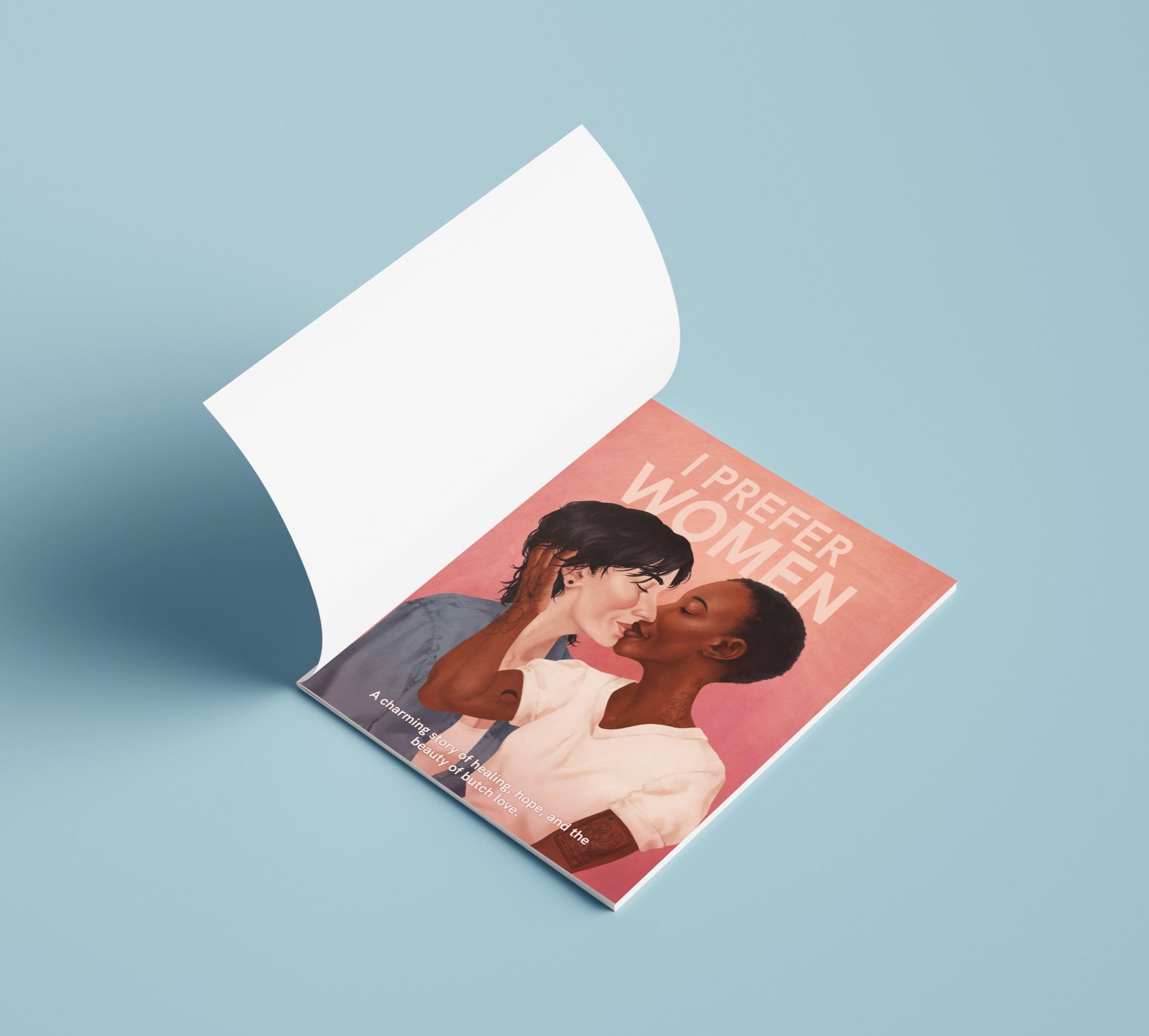
project overview
This was a project from my Illustration class exploring the responsibilities illustrators have with regards to how certain issues and groups of people are represented in their work. Stereotypes and cliches are far too common in pop culture, and while many people do not think twice about these portrayals of different people, harmful portrayals of minority groups can greatly alter how those individuals internalise their own identities and struggles, but also how larger society conceptualises them.
For my project, I decided to explore the representations of butch women, more specifically butch lesbians, to make my topic both specific and of personal interest. In general, representations of queer characters are often rooted in homophobic stereotypes. They are often flat, one-dimensional side characters, if they are even included in media at all. Many queer identities are not included in visual media at all, butch women among them, making them invisible in the cultural zeitgeist. Despite this erasure, butches have long since been a pillar of the LGBTQ+ community, and have existed for decades. I wanted to address this issue, and bring awareness to it, and celebrate the beauty and strength in butch identity.
The final deliverables for this project was one illustration, a research report, and a rationale explaining how and why the research informed the illustration, assembled into a publication. Here I go over my research and some of my findings, the finished illustration and rationale as it has been informed by my research, and my bibliography.
the research
The research for this project consisted of understanding the history behind butch and femme identities in the lesbian community, familiarising myself with historical depictions of butch lesbians, if there were any at all, and with more recent depictions of butch lesbians
butch and femme identities
In a world where fetishized and sexualized depictions of lesbians are frequent, the idea of a woman performing masculinity is seen as undesirable, and butch women are often excluded in depictions of lesbians, which has made them invisible in the pop culture zeitgeist.
Butch and femme identities have existed for years before the terms entered our lexicon, though these individuals would not use such language to identify themselves. To define butch is difficult, but typically connotes a masculine appearance and way of dress, a certain swagger and confidence (Theophano, 2004; Manders, 2020; “Butch and femme”, 2022).
In the 1940s and 50s, there were important rules to follow to be able to safely participate in early gay bar scenes, one of these presenting as either butch or femme. Women who were neither butch or femme were treated with distrust; they were called “kiki” women, or “confused” (Theophano, 2004). This was a time of violent homophobia, where police officers would go undercover to infiltrate bars (Theophano, 2004; “Butch and femme”, 2023).
early representations — 40s and 50s
Some of the earliest representations of lesbians come in the form of lesbian pulp fiction novels. Written between 1950 and 1965, by both men, women, and lesbians alike, these were novels depicting lesbian relationships that were targeted for straight men (Blakemore, 2019). While these covers would depict lesbians on the cover, they were always very conventionally feminine, even if some of the characters were described in ways we would see as butch.
One example is Ann Bannon’s infamous character Beebo Brinker; despite the fact that Beebo Brinker is undeniably a butch lesbian in the text of the novel, she is portrayed as a waifish, demure woman on the cover, irregardless of how she is described in the novel (Frost, 2018; “Beebo Brinker”, 2022).
Pages from my research report; this showcases some examples of lesbian pulp covers, but there are literally hundreds of them. Please click to see details.
later representation — 60s and 70s
Butches became a more visible identity during the 60s and 70s, becoming a part of civil, gay, and women’s rights movements (Manders, 2020). The photographer JEB began her work photographing lesbians in this time period. She sought to represent lesbians in a more authentic, intimate way, removed from the male gaze, and her work was a major inspiration for this project. JEB published her work in books such as Eye to Eye: Portraits of Lesbians (1979) and Making a Way: Lesbians Out Front (1987), and a slideshow called “Lesbian Images in Photography: 1850 - the present” which toured between 1979 and 1985 (Moakley, 2021; Goodman, 2019).
Despite this, butches faced brutal discrimination — not just from homophobic outsiders, but also from within the LGBTQ+ community. In the late 70s and early 80s, there was a “brand” of feminism that “marginalised certain sorts of “otherness” — working-class lesbians, lesbians of colour and masculine-of-centre women'' (Manders, 2020). This discourse once again caused butch women to be erased from mainstream popular culture.
More pages from my research report, showcasing both the character Beebo Brinker and how she is depicted, as well as a selection of JEB’s photography to juxtapose it. Please click to see details.
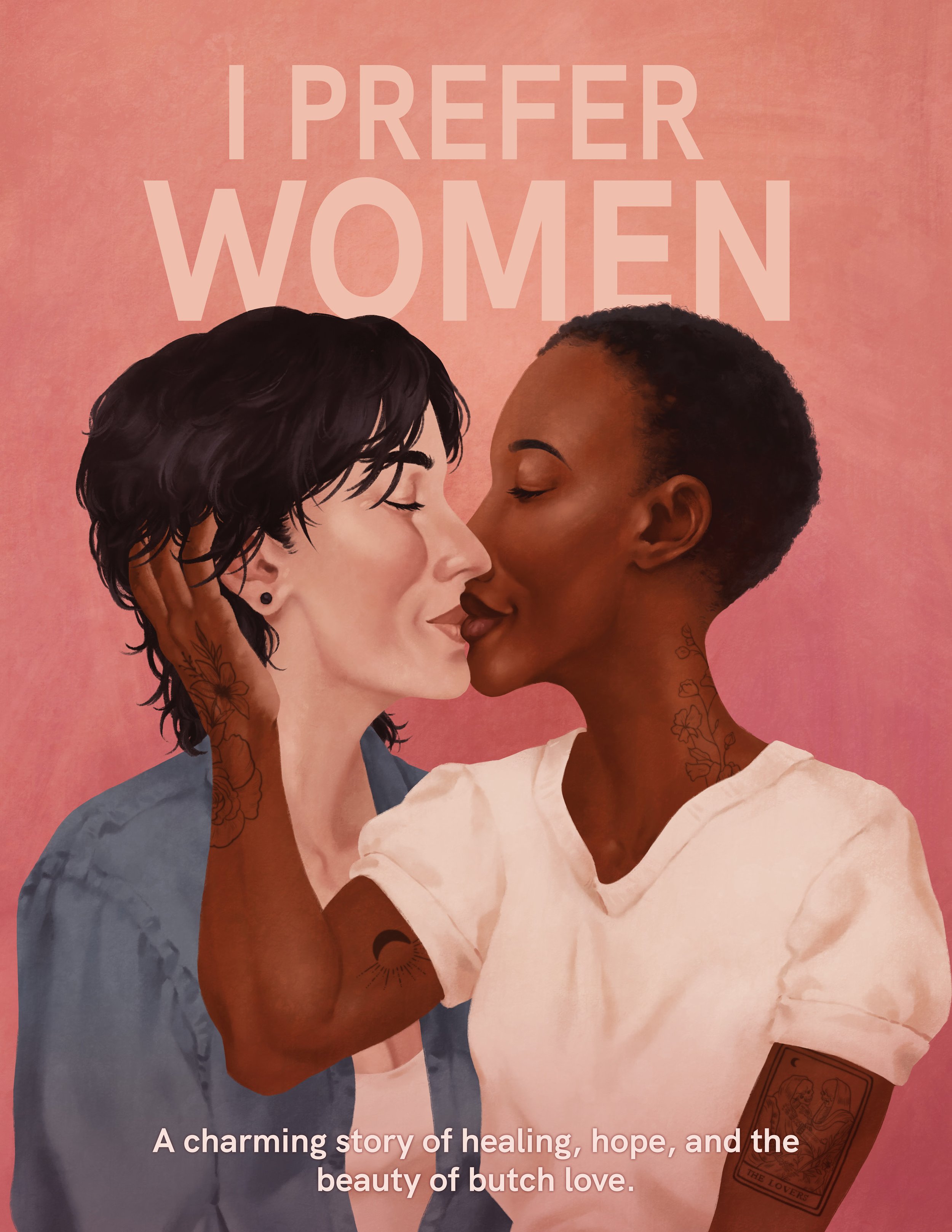
final illustration
rationale
Essentially, I wanted to readdress the harmful covers of lesbian pulp novels with an approach based on empathy and celebration for butches, rather than objectifying lesbians and lesbian relationships.
First, I wanted to address the historical and systemic erasure and exclusion of butches from lesbian representation, and the way butches in relationships with each other are almost never depicted; historically, the ideal lesbian relationship was between a butch and femme. This goes all the way back to how butches were treated in the 70s and 80s, but it is still an issue in the lesbian community today (Manders, 2020).
At one point during critique, the idea of readdressing lesbian pulp covers was brought up as a way to approach this project. I wanted to look back to these illustrations, and see how they can be readdressed and critiqued decades later, hopefully to a more reaffirming effect. To do this, I referenced the title from I Prefer Girls, and replaced it with I Prefer Women, and then tweaked the tagline to be more positive than negative.
Second, I wanted to address the way lesbians are often sexualized for the gratification of straight men. This was a problem during the 50s with lesbian pulps, and is still a problem today, and it dehumanises these women into objects without agency or willpower. However, the photographer JEB and her work completely turns this narrative on its head. Her work, while intimate and romantic, is not dehumanising, nor erotic. Her photographs are intimate snapshots of the lives of lesbians and their day-to-day lives. The viewer is privileged to be allowed into this sacred space, and this gentle lens showcases the beauty of love. The touching way JEB captured her subjects was exactly how I wanted to approach my illustration. While this is very much so an illustration celebrating butch identity, it is also an illustration that celebrates the power of love.
Lastly, I wanted to address the way mid century illustration almost exclusively represented heteronormative, thin, conventionally attractive white characters. I wanted my characters to be diverse, and realistic, much like the subjects in JEB's photography. I wanted them to have short hair, no make up, piercings and tattoos. There is meaning in the tattoos as well; they symbolise growth, healing, and of course, love.
bibliography
Blakemore, E. (2019, August 1). Pulp Fiction Helped Define American Lesbianism. Jstor. https://daily.jstor.org/pulp-fiction-helped-define-american-lesbianism/
Beebo Brinker. (2022, September 14). In Wikipedia. https://en.wikipedia.org/w/index.phptitle=Beebo_Brinker&oldid=1110194002
Butch and femme. (2023, February 6). In Wikipedia. https://en.wikipedia.org/w/index.php?title=Butch_and_femme&oldid=1137774842
Davis, L. S. (2020, May 28). The Rise of Butch Leading Ladies on TV. Shondaland. https://www.shondaland.com/inspire/a32689332/rise-of-butch-leading-ladies/
Frost, N. (2018, May 22). The Lesbian Pulp Fiction That Saved Lives. Atlas Obscura. https://www.atlasobscura.com/articles/lesbian-pulp-fiction-ann-bannon
Goodman, E. (2019, May 30). Without JEB’s Photography, The World Wouldn’t Know Lesbian History. Them. https://www.them.us/story/jeb-photography-lesbian-history
Kettler, S. (2020, April 14). How Ellen Degenres’ Historic Coming Out Episode Changed Television. Biography. https://www.biography.com/movies-tv/ellen-degeneres-sitcom-coming-out-episode
Manders, K. (2020, April 13). The Butches and Studs Who've Defied the Male Gaze and Redefined Culture. New York Times. https://www.nytimes.com/interactive/2020/04/13/t-magazine/butch-stud-lesbian.html
Moakley, P. (2021, February 13). How a Groundbreaking Book Helped a Generation of Lesbians See Themselves in the 1970s. Time. https://time.com/5938729/eye-to-eye-portraits-of-lesbians-jeb/
Theophano, T. (2004). Butch-Femme. GLBTQ Archive. http://www.glbtqarchive.com/ssh/butch_femme_ssh_S.pdf